
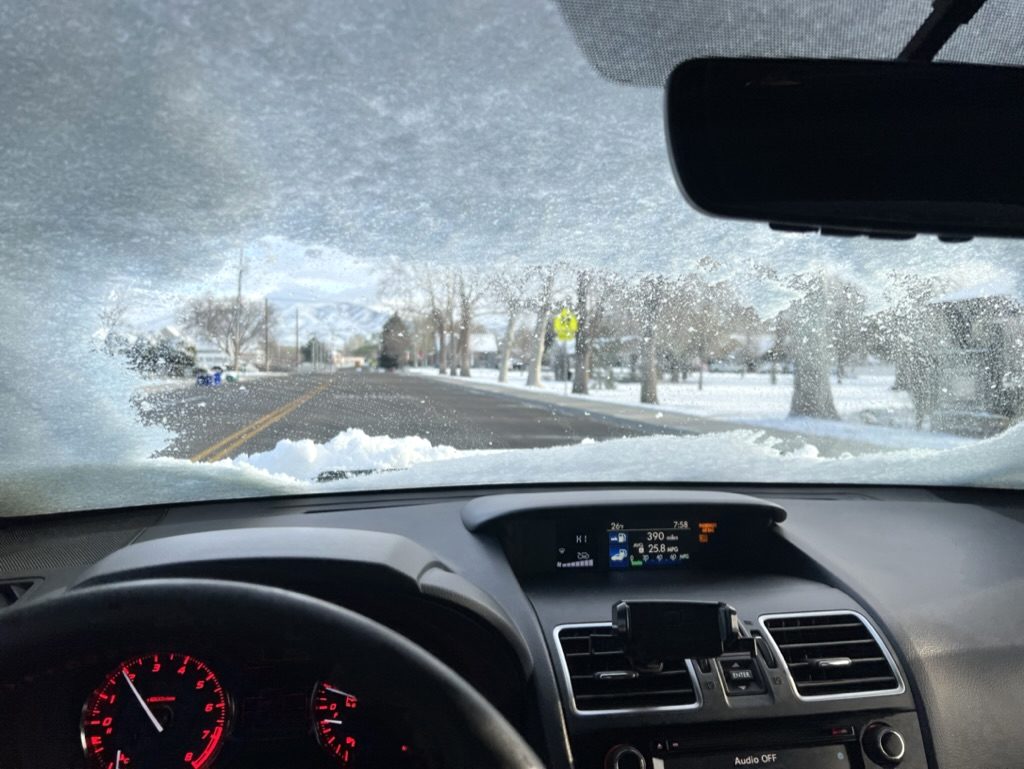
Here is the deal. Your first Lehi winter is going to be gorgeous. The mountains go white, the air smells clean after a storm, and you will take way too many photos of Timpanogos. Then one morning you will walk out to a driveway that faces north, sits at an angle, and has turned into a luge track overnight. Both of those things are true. I would rather you hear about the second one from me than from your tailbone.
Let me tell you about my neighbor Neal. Neal has heavy machinery, and Neal makes sure our neighborhood is always taken care of. When the snow comes, our roads get cleared. And the kids? They get a snow pile big enough to play on like it is their own private mountain. I did nothing to deserve Neal. I just bought the right house.
But here is the honest truth. Not every neighborhood has a Neal. For those that don't, here is the good information.
If you are moving to Lehi for a job on Silicon Slopes, or just eyeing a home before the snow flies, this is what I would want you to know.
How snow removal actually works here
Lehi City publishes its plowing priorities, and they are worth reading before you pick a street. In plain English:
- Priority 1 is the main arterial roads with the most traffic, including school and bus routes.
- Priority 2 is other main roads with heavy traffic or public safety concerns.
- Priority 3 is residential areas.
- Priority 4 is subdivisions, cul de sacs and end streets, and the city says those are plowed after four inches of snow or more.
The city is also clear that during a heavy storm, residential roads probably will not be reached right away, because the main roads have to be plowed again and again. So if you fall in love with a quiet cul de sac, love it with your eyes open. Quiet in July can mean last in line in January.
A few other things the city spells out that new residents miss:
- Not every road is the city's job. Lehi lists Redwood Road, Main Street, State Street, 2100 North and Timpanogos Highway as UDOT roads, and private roads are handled by whoever owns them. If you are looking at a community with private streets, ask the HOA who plows and how fast.
- Winter parking rules are real. The city brochure says parking on public streets is prohibited from November 1 to March 30 between 10 p.m. and 7 a.m., and also during or within 24 hours after a storm. If the house you like only works because everyone parks on the street, that is a winter problem.
- You clear your own stuff. Property owners are responsible for driveway openings, the sidewalks next to their property, and the snow around fire hydrants and mailboxes.
- Do not blow your snow into the street. The city prohibits it by ordinance, and its right of way for snow storage extends nine feet from the curb. Fancy landscaping in that strip is at your own risk.
The peephole scrape, and why it is a bad idea
That photo up top is mine. It is a very Utah move: scrape a hole the size of a dinner plate, squint through it, and hope for the best. I know. I did it. Here is what that hole actually means.
Utah law says a person may not operate a motor vehicle with "any debris, frost, or other substance that materially obstructs the operator's view." That is Utah Code 41-6a-1635. My little peephole? Pretty sure that counts as materially obstructed.
The Utah Highway Patrol says it plainly too: "Before moving your vehicle, clear ALL ice and snow off your windows, headlights, and tail lights." And a UHP lieutenant told Fox 13 that snow left on your roof "may actually slide down if you hit your brakes and slide down over your windshield." So you clear the windshield, tap the brakes, and your roof gives it right back. Love that for you.
So here is what I do now, mostly:
- Warm up early. Start the car a few minutes before you leave and let the defroster do some of the work.
- Clear the whole windshield, not a peephole. Then the back window and the side windows.
- Clear your mirrors so you can actually see who is behind you.
- Brush off your headlights, brake lights and signals so people can see you.
- Clear the roof. Yes, the roof. The person behind you will never know you did it, and that is the point.
- Keep a real scraper and brush in the car, not a credit card and good intentions.
The inversion, explained like a neighbor would
Nobody puts the inversion in the relocation brochure, so let me. Normally air is warmer near the ground and colder up high. In an inversion, cold air gets trapped near the valley floor under a layer of warmer air that acts like a lid. Utah DEQ says it often shows up after a snowstorm, with calm winds, clear skies and long nights, and that mountains make it stronger by forming a basin. They specifically name Traverse Mountain as one of the ranges that helps trap cold air in the Salt Lake Valley.
What gets trapped under that lid is pollution, mostly fine particles called PM2.5. DEQ says a typical Utah winter sees about five to six multi day inversion episodes, and that a strong storm is often what clears it out. They also say PM2.5 has been linked to aggravated asthma and reduced lung function.
If I were you, I would do three things:
- Download the Utah Air app or check DEQ's air quality page on gray days, especially if anyone in your house has asthma.
- Plan indoor stuff for those stretches. Lehi is not short on it.
- When you look at homes, ask about the furnace filter setup and whether there is a wood burning fireplace you actually plan to use. DEQ lists wood smoke as one of the sources that gets trapped.
Which hills and streets get icy
I am not going to hand you a list of "bad streets," because the city does not publish one and I am not going to make one up. What I can tell you is the pattern, and you can test any street against it.
- Low priority streets on a grade. A hill that is also a Priority 4 end street gets plowed later, and that is the combo that bites.
- North facing slopes and shaded spots. Snow that sits in shade melts slower and refreezes. The city brochure also notes that wet, heavy snow can get very slippery when it freezes on the pavement.
- Packed snow on busy roads. Lehi's own brochure says snow on heavily traveled roads often gets packed down by cars, which makes it harder to remove.
- The bench and foothill areas. If you are shopping on the higher ground around Traverse Mountain, the views are the reward and the grades are the price. Drive it in the snow before you sign.
The driveway direction secret nobody tells you
Here is the thing I wish someone had told me before my first winter. You could be on the same street as your neighbors and have a totally different winter, just because of which way your driveway faces.
My house faces south. I rarely even need to shovel. By the time the sun pops out, my snow is melted. Meanwhile, across the street, my neighbors have ice building up in their driveways because they sit in the shade. Same street. Same storm. Very different mornings. I try not to look smug about it. I fail.
There is real science behind it. NASA explains that in the mid latitudes north of the equator, the sun's daily trip is an arc across the southern sky, and it sits lowest in midwinter. A University of British Columbia snow science course puts it in snow terms: in winter the sun tends to be in the southern part of the sky, so it strikes south facing slopes more directly, while east and west facing slopes get less than south but more than north. So here is how I rank them:
- South facing is the winner. Your driveway gets the most winter sun, and snow often melts off before you even find your gloves.
- West facing is good. You get the afternoon sun, and that same UBC course notes westerly slopes get their sun when the air is warmest. Great for melting off what the morning left behind.
- East facing gets morning sun only. That helps, but morning is usually the coldest part of the day, so it does not do as much.
- North facing is the shady one. That is where ice builds up and hangs around for days. Not a deal breaker, just budget for a good shovel, some ice melt and a little patience.
What to check at a showing
- Pull out a compass app and stand in the driveway facing the street. Check which way it faces. You will look a little weird. Do it anyway.
- Look across the street. If you visit after a storm, compare your side to theirs. The difference tells you everything.
- Notice trees, tall fences or a neighbor's two story house that could shade a south facing driveway anyway.
- Check where the snow will go. You cannot blow it into the street in Lehi, so picture where a winter's worth of it gets piled.
- Look at drainage. If melt runs across the driveway or toward the garage, it can refreeze there at night.
- Check the plow priority of the street and your route out to a main road on the city's snow plow route map.
- Slope matters too, just less than direction. A steep north facing driveway is the combo I would think hardest about.
Is winter a reason not to move here?
Nope. It is a reason to choose your street on purpose. Lehi in winter is cozy, close to the canyons and honestly pretty fun once you have your rhythm. You just do not get the snow globe views without the shovel. Anyone who tells you otherwise is selling you something.
And if your new street comes with a Neal, bring him cookies. Often.
If you want the bigger picture on the city, start with my Lehi and nearby cities page. More local stuff lives on the blog.
If you are trying to figure out where to land before your first winter here, I will put together a free shortlist of three Lehi neighborhoods that fit your commute, your budget and your tolerance for shoveling. Tell me what you need and I will send it over.
Questions people ask
Does Lehi plow residential streets?
Yes. Lehi City plows residential areas as Priority 3 after main roads are clear. Subdivisions, cul de sacs and end streets are Priority 4 and are plowed after four inches of snow or more, per the city's snow removal brochure.
Can I park on the street in Lehi in winter?
Lehi City's snow removal brochure says parking on public streets is prohibited from November 1 to March 30 between 10 p.m. and 7 a.m., and during or within 24 hours after a snow storm.
What is the Utah inversion?
Utah DEQ describes it as cold air trapped near the valley floor under warmer air, which acts like a lid and holds pollution such as PM2.5 near the ground. It often follows a snowstorm with calm winds and clear skies.
Who is responsible for shoveling sidewalks in Lehi?
Lehi City says property owners are responsible for clearing driveway openings, the sidewalks next to their property, and snow around fire hydrants and mailboxes.
Why does a south facing driveway matter in Utah?
In the Northern Hemisphere the winter sun stays low and travels across the southern sky, so south facing driveways get the most direct sun and tend to melt off faster. North facing driveways sit in shade and are more likely to build up ice.
How do I check which way a driveway faces?
Stand in the driveway facing the street and use a compass app on your phone. Then look across the street after a storm to compare.