
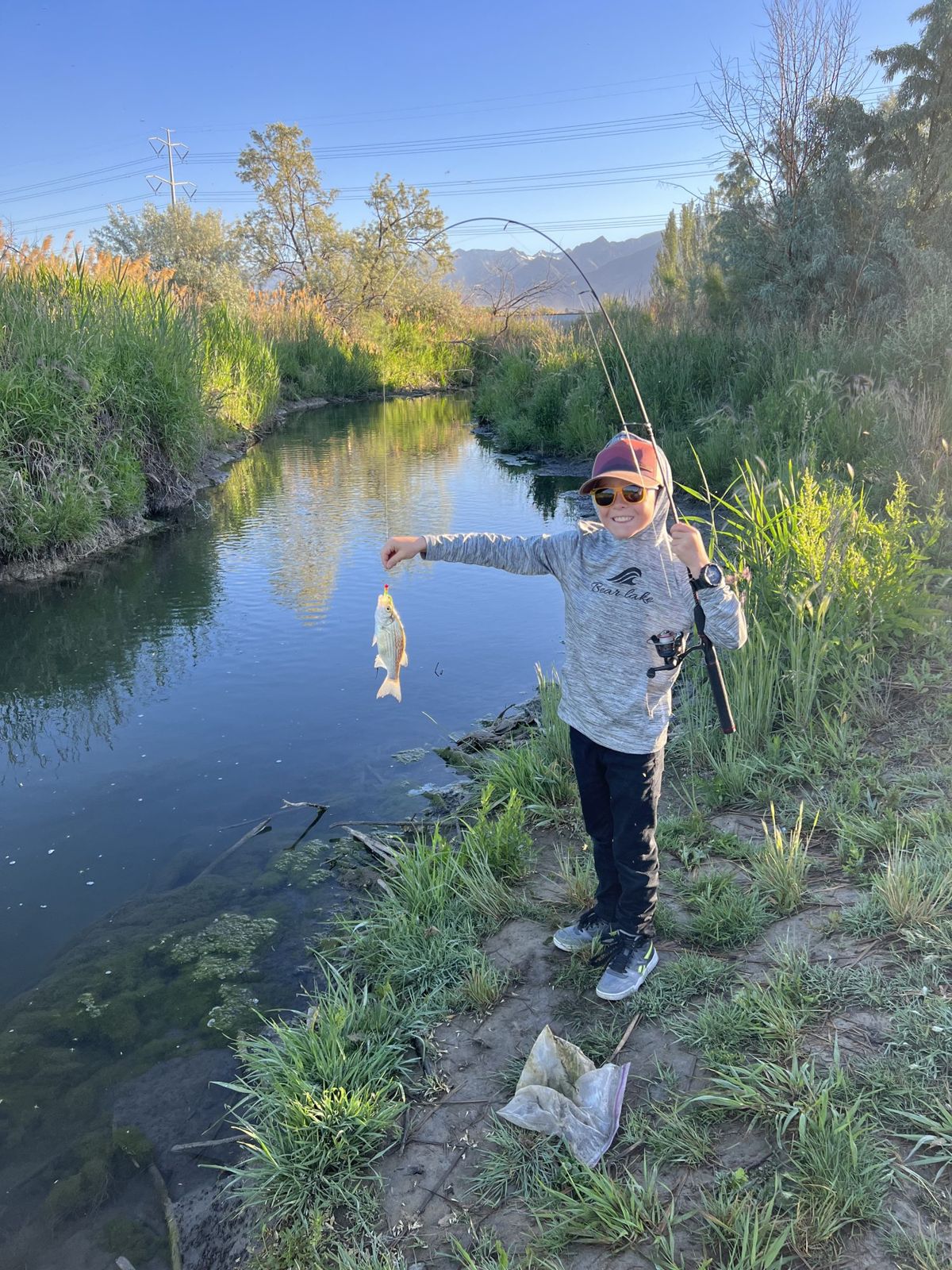
Some people talk about Utah Lake like it is the river behind the nuclear plant in The Simpsons. You know the one. The fish has three eyes, and everybody acts like eating it will give them a fourth.
I understand where that comes from. I also fish it. And I have some news, some of it good, some of it about mosquitoes.
Here is the whole post in one sentence. This is a lake you may not want to live on the shore of, but it is absolutely beautiful from a couple streets over. The shoreline has smells, bugs, algae, and mud. A couple streets back, you get the view and skip most of the rest. That is not a knock on the lake. That is just knowing the lake.
Here is my honest take. The white bass fishing in the spring is amazing. In my experience, you can literally catch 150 fish in a day if you want. I did not say you should. I said you can. Your forearms will file a complaint. Your forearms do not get a vote.
White bass: why the spring run is the whole show
According to the Division of Wildlife Resources' proposed Utah Lake Fisheries Management Plan (presented in August 2026), white bass are the most numerous sport fish in Utah Lake, and often the most abundant fish of any kind in the DWR's sampling1. The same plan reports that in a 2017 spring angler survey, about 83 percent of the total catch was white bass1. Those are survey numbers, not rules, but they make the point. So when I say there are a lot of them, that is not just me being dramatic. The state has a chart. I trust a chart more than I trust me.
The limit. As of the 2026 Utah Fishing Guidebook, the statewide daily limit on white bass is no limit2. The guidebook's rules for specific waters do not list a separate white bass limit for Utah Lake2. Rules change every year, so check with the DWR before you go. "No limit" is a fishing rule. It is not a life philosophy. I had to learn that separately.
When. It depends on water temperature, not the calendar. A Brigham Young University study of Utah Lake white bass documented spawning starting in early May, when the water hit about 63 degrees, and continuing into mid June3. Males showed up near the spawning areas earlier, in late March and April3. Anglers tend to find them stacked near creek mouths, boat harbors, and the Provo River inlet in spring4. By midsummer they scatter into open water and you have to work for it4. I do not love working for it. That is why I go in spring.
Where. Think inlets. The Provo River is the lake's one large flowing tributary3. The American Fork and Spanish Fork areas, plus smaller creek mouths and harbors around the lake, are where a lot of people start3,4. If you see a line of people standing very close together and nobody is talking, that is probably the spot. Do not ask them how it is going. They will say "slow." They are lying.
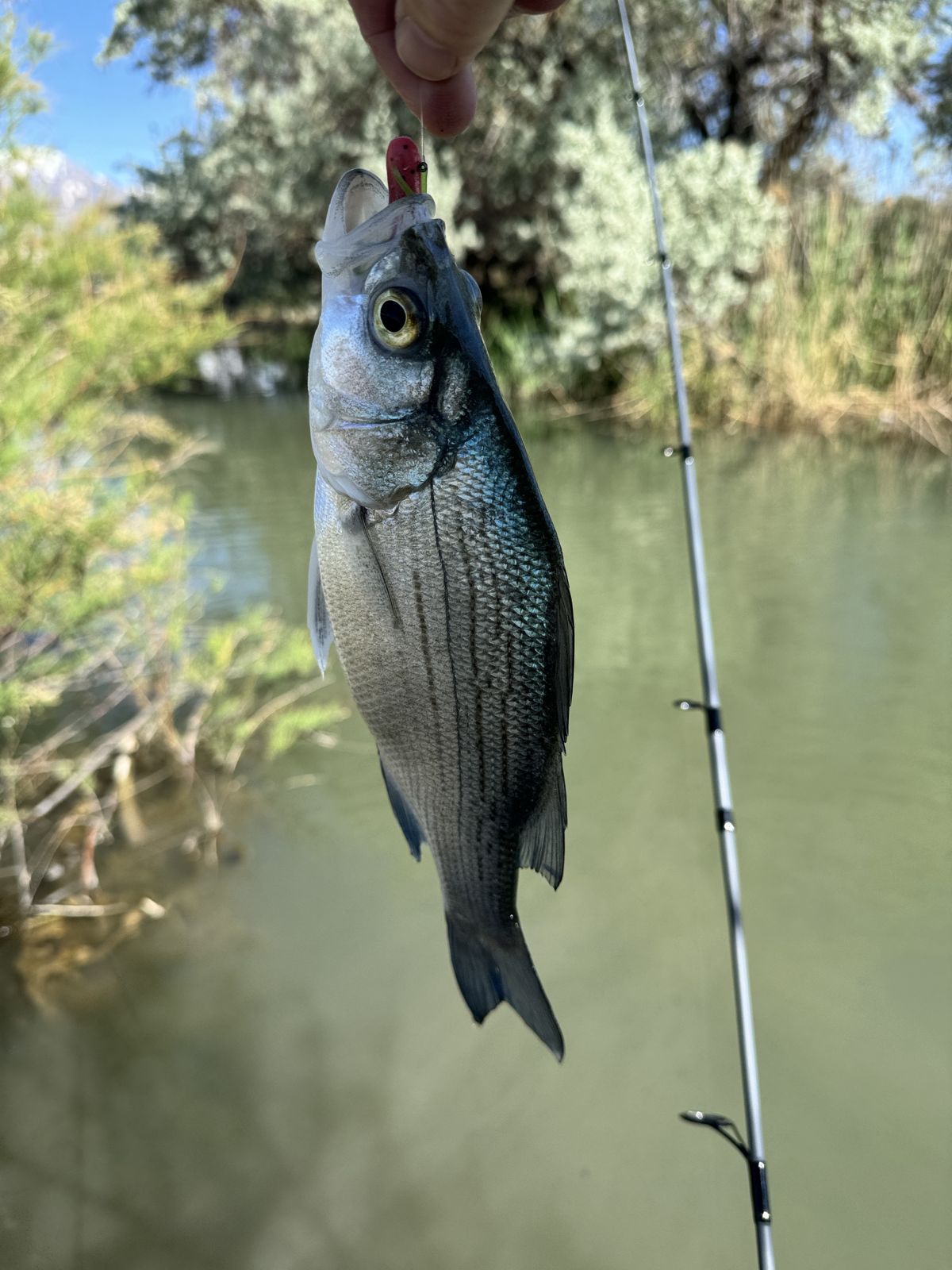
My go to lure. Tiny watermelon jigs. I would always slay the white bass on them. I have a whole tackle box, and I use one color. The rest of the box is there for emotional support.
A few other rules worth knowing (as of the 2026 Utah Fishing Guidebook; check the DWR before you go)
- Dead white bass may be used as bait only in Utah Lake and the Jordan River2,5.
- Underwater spearfishing is allowed for white bass and northern pike in Utah Lake and in these tributaries west of I-15: American Fork Creek, Beer Creek, Dry Creek, Hobble Creek, Spanish Fork River, Spring Creek, and Spring Creek Run2,5.
- Spearfishing is not permitted in the Provo River or the Provo River Delta2,5.
- Anglers 12 and older need a valid Utah fishing or combination license2.
So can you actually eat the fish?
This is the part where the three eyed fish reputation runs into the actual paperwork.
Utah's fish consumption advisories are published by the Department of Environmental Quality, with the health guidance set by the Department of Health and Human Services9. Here is what the current list says about Utah Lake.
- Channel catfish have an advisory, for PCBs. Adults and kids 6 to 16 should limit it to two 6 ounce servings a month. Pregnant or nursing women and kids under 6 should not eat it9. So the catfish is the one with the asterisk.
- Carp no longer have one. In June 2026, after roughly two decades, the state lifted the PCB advisory on Utah Lake carp after testing found levels low enough to be in the safe category10,11. State water quality officials said PCB levels in carp had fallen more than 80 percent over about 20 years10. As the head of the Utah Lake Authority put it, maybe you don't want to eat carp, but that's not really the story10. I agree. The story is that the lake got cleaner. Whether carp tastes good is a separate investigation and I am not leading it.
- White bass are not on the advisory list. Utah Lake's only listed advisory is channel catfish9. The DEQ explains that a species not on the list has either not been tested at that location or tested within safe levels9. So I am not going to tell you a lab blessed your white bass. I am going to tell you the state has no advisory on it.
The DEQ's general tips are worth following anywhere: eat smaller fish, and remove the skin and organs before cooking, though some contaminants are stored in the meat and cannot be cooked out9. Check the DEQ list before you keep fish from any Utah water, because it changes9.
Zero extra eyes, as far as the state is concerned. I still count. Old habits.
Carp: bowfishing and spearfishing (yes, it is legal, with rules)
From about April through June, in my experience, you can see carp right along the shore. A lot of them. Big ones. Just cruising, like they pay property tax. Some people see that and think, gross. Other people see that and go get a bow.
I checked whether this is legal, because I would like to keep doing things legally. I have a lot going on. Here is what the adopted rules say as of the 2026 Utah Fishing Guidebook and the state's fishing rule2,5. Check the DWR before you go, because these get updated.
- It is legal. With a valid Utah fishing or combination license, you may take common carp in any water during its open fishing season using angling, traps, archery, dipnets, cast nets, liftnets, seines, a crossbow, an airgun using archery tackle, a handheld spear from above the water, or underwater spearfishing2,5.
- Bows are for nongame fish only. Bowfishing is allowed only for nonprotected nongame fish such as carp. Crossbows and arrow firing airguns may be used only for carp2.
- Lights are allowed. You may use artificial light while bowfishing or spearfishing for carp2,5.
- Night bowfishing closure. The Utah Lake tributaries, the Provo River from the Center Street bridge at the state park entrance up to I-15, and the Provo River Delta are closed to nighttime bowfishing (sunset to sunrise) from the first Saturday of May through 6 a.m. on the second Saturday of July2.
- No spearfishing in the Provo River or its delta, carp included2,5.
- Do not leave them on the bank. Lawfully taken nongame fish must be either released or killed immediately, and may not be left or abandoned on the shoreline5. Nobody wants to walk past your carp. Least of all the next guy.
- Release every sucker. In the Utah Lake tributaries and the Provo River sections near the lake, all suckers must be immediately released2.
June sucker: do not take it. The June sucker lives only in Utah Lake and the rivers it spawns in6. It is listed as threatened under the federal Endangered Species Act6,7, and Utah classifies it as a prohibited fish that may not be taken or possessed. If you catch one by accident, release it immediately5. If you are not sure whether it is a carp or a sucker, do not shoot. That is my rule, not the state's. But it is a good rule.
Separately, the DWR has proposed changes to bowfishing and baitfish rules for future years, including some specific to Utah Lake8. Those are proposals, not adopted rules, as of this writing. So treat this whole section as a summary, not a permission slip. Check the current guidebook and the DWR every year before you shoot2.
The carp dog food rumor
The rumor I heard: big companies are coming in to scoop the carp out of Utah Lake and grind them up into dog food. Which, if true, means somewhere a golden retriever is eating better than me.
Turns out, the removal part is very real. The pet food part is more of a "people talked about it."
- It is a real, organized removal program. Pulling carp out of the lake is one of the main jobs of the June Sucker Recovery Implementation Program, done through commercial fishing by Loy Fisheries12. Carp tear up the plants on the lake bottom where young June sucker hide12,13.
- The amounts are huge. The recovery program reports more than 29 million pounds of carp removed, with an average annual harvest nearing 4 million pounds, and a 78 percent decline in carp density since 201212. In June 2026, Utah Lake Authority officials said more than 30 million pounds had been removed since 201010. That is a lot of carp. I tried to picture it and my brain just showed me a loading screen.
- Where the carp went, at least early on. In the early years of the program, around 2009, reporting found most of the removed carp went into a farmer's fields as compost and fertilizer, and to a mink farm in Utah County13,14. A Salt Lake Tribune report from that era quoted the commercial fisherman saying some were shipped to Canada, and most became compost15. I could not find a recent source on where they go now, so I am not going to guess.
- And the pet food? It came up. Back then, a BYU researcher proposed liquefying carp into a product that could be used as fertilizer, trout feed, or a pet food ingredient, and pet food was on the list of ideas floated for the fish. But at the time, no investors had stepped forward to build that facility16,14. So your dog's kibble is probably safe from Utah Lake. Probably. I cannot speak for every bag.
So the rumor is about half right, which, for something I heard at a barbecue, is honestly a great percentage.
Not deep, but beautiful
Utah Lake covers roughly 148 to 150 square miles and is one of the largest natural freshwater lakes west of the Mississippi17,18. It is also shallow. The average depth is about 10 feet and the deepest spots are around 14 feet17,18. Very large and not very deep. I have been described the same way.
The water looks cloudy because the lake bed is thousands of feet of sediment17. Cloudy is not the same as dirty. It is just what this lake looks like. Some of us are not photogenic either, and we are doing fine.
And in my opinion, it is beautiful. Especially from the Saratoga Springs side. Looking east across the water at sunset, with the light hitting the Wasatch, is one of my favorite views in the county. This is where the whole idea comes together for me: you may not want to live right on the shore of this lake, but it is absolutely beautiful from a couple streets over. The view travels. The shoreline smell mostly does not. If you are looking at homes on the west side of the lake, my Saratoga Springs guide goes deeper.
Same lake, very different smell
Here is something nobody tells you. Utah Lake is not one experience. It depends a lot on where you stand.
The lake at the Lindon boat harbor is much different than the lake near Saratoga Springs near the hot pots, where it smells like death, old water, and your gassy uncle Ned. Everybody has an Uncle Ned. If you do not, you might be Uncle Ned. I am not here to judge. I am here to warn.
To be fair to the hot pots, that smell is nature, not neglect. The pools locals call the hot pots are Saratoga Hot Springs, natural thermal springs on the north shore reached by a short trail from the city's Inlet Park21,22. The Utah Geological Survey ties these springs to the Utah Lake fault zone, where groundwater circulates deep, heats up, and comes back to the surface23. Visitors regularly describe a sulfur smell24. So the earth is basically burping, and you are standing in it. The city even notes the springs themselves sit just outside its boundary, with only the trailhead inside city limits22. Which feels like the city quietly saying, that smell is not technically ours.
The views from that side are still some of my favorites. The smell right at the hot pots, not so much. Both things are true. Enjoy the sunset from upwind.
Over at the Lindon Marina, a privately run harbor with launch ramps and a sheltered harbor on the northeast side of the lake25, the experience is more boats and docks. And the smell, in my opinion, is just regular lake. Which, after the hot pots, smells like a candle. That is a smell comparison only. It is not a water quality report. Algae advisories get posted at that marina, like everywhere else on the lake. As of the DEQ's September 30, 2026 update, Lindon Marina Beach was under a danger advisory and the whole lake was under a warning, so check the DEQ algae page before you launch20. If you want to read more about that side of the lake, my Lindon guide is a good place to start.
What will test you
Loving a place honestly means telling you the hard parts.
- The mosquitoes. The other thing that keeps people away from Utah Lake is the infinite amount of mosquito clouds. Not a cloud. Clouds. Plural. At some point you stop swatting and just accept that you are part of the food chain now. Utah County runs a mosquito abatement district, and summer spraying typically starts after Memorial Day and runs to about mid September19. That helps. It does not make you invisible. Bring bug spray. Bring more bug spray than you think. Then put on the bug spray you forgot you brought.
- The algae. Utah Lake is nutrient rich and gets harmful algal blooms in warm months18,20. Some summers, parts of the lake are not a good idea for swimming or for your dog. Before any water contact, check the Utah DEQ Utah Lake page20. If it says stay out, stay out. Your dog will not understand. Your vet will.
- The reputation. You will tell people you went fishing at Utah Lake and they will make a face. Let them. More white bass for you.
What I would do if I were you
- Get your license, and read the current Utah Fishing Guidebook. It is free, and it is shorter than it looks2.
- Go in spring when the water warms up, and start near an inlet or harbor3,4.
- Tie on a tiny watermelon jig. Then try not to look smug. You will fail. That is fine.
- If you bowfish or spear carp, follow the night closures, keep away from the Provo River and its delta with a spear, release every sucker, and do not leave carp on the shore2,5.
- Check the DEQ fish advisory list before you keep anything, and the DEQ algae page before you or your dog get in the water9,20.
- Bug spray. I have said it already. I am saying it again.
- Stay for sunset. Especially on the west side.
I love this lake. It is not the lake people imagine, and it is not the three eyed fish lake people joke about. It is a big, shallow, cloudy lake full of fish and mosquitoes, and it puts on a pretty good show at the end of the day. So here is where I land. This is a lake you may not want to live on the shore of, but it is absolutely beautiful from a couple streets over. Bring a jig. Bring bug spray. Stay for the sunset. If you are still figuring out where you want to land in Utah County, start with my Where should I live? guide and I'll point you in the right direction.
Still deciding where to land in Utah County? Start with my Where should I live? guide and the area map, or text me and I'll tell you the honest version of any neighborhood.
Sources
- Utah Division of Wildlife Resources, Utah Lake Fisheries Management Plan, PROPOSED (Aug. 2026 RAC packet; cited for survey data only, not rules): link
- Utah Division of Wildlife Resources, 2026 Utah Fishing Guidebook (version 2026.1): link
- Frederic Vincent, "Spawning ecology of the white bass Roccus chrysops (Rafinesque) in Utah Lake, Utah," Great Basin Naturalist 28(2), 1968, Brigham Young University: link
- Utah Lake Fishing, Fishing Report (seasonal angler notes): link
- Utah Administrative Rule R657-13, Taking Fish and Crayfish: link
- U.S. Fish and Wildlife Service, "June sucker has moved from Endangered to Threatened": link
- U.S. Fish and Wildlife Service, Reclassification of the June Sucker to Threatened, Final Rule (86 FR 192, Jan. 4, 2021): link
- Utah Division of Wildlife Resources, PROPOSED changes to Administrative Rule R657-13 (Aug. 2026; not adopted as of this draft): link
- Utah Department of Environmental Quality, Utah Fish Consumption Advisories: link
- KSL, "'A major victory': It's now safe enough to eat the carp at Utah Lake" (June 10, 2026): link
- ABC4, "20-year health advisory lifted at Utah Lake, carp are once again safe to eat": link
- June Sucker Recovery Implementation Program, Managing Non-Native Fish: link
- Associated Press via San Diego Union-Tribune, "Utah Lake's excess carp become mink food, compost" (March 13, 2009): link
- Deseret News, "Goal is to take 30M lbs. of carp from Utah Lake" (Nov. 22, 2009): link
- The Salt Lake Tribune, "Whatever happened to ... fishing Utah Lake for carp to feed low-income Utahns?": link
- BYU Y Magazine, "Carpe Carp": link
- Utah Lake Authority, 2026 Annual Report: link
- Utah Lake Authority, Frequently Asked Questions: link
- Utah County Health Department, Mosquito Abatement: link
- Utah Department of Environmental Quality, Utah Lake Recreational Water Quality Monitoring: link
- City of Saratoga Springs, Inlet Park (trailhead for the Saratoga Hot Springs): link
- City of Saratoga Springs, Parks and Trailheads (Saratoga Hot Springs Trail, natural hot springs outside the city boundary): link
- Utah Geological and Mineral Survey, Summary of Low Temperature Geothermal Studies, Report of Investigation 193: link
- AllTrails, Saratoga Hot Springs Trail (visitor descriptions of a sulfuric odor): link
- Utah Lake Authority, "Launch into summer at one of five Utah Lake marinas" (Lindon Marina listing): link